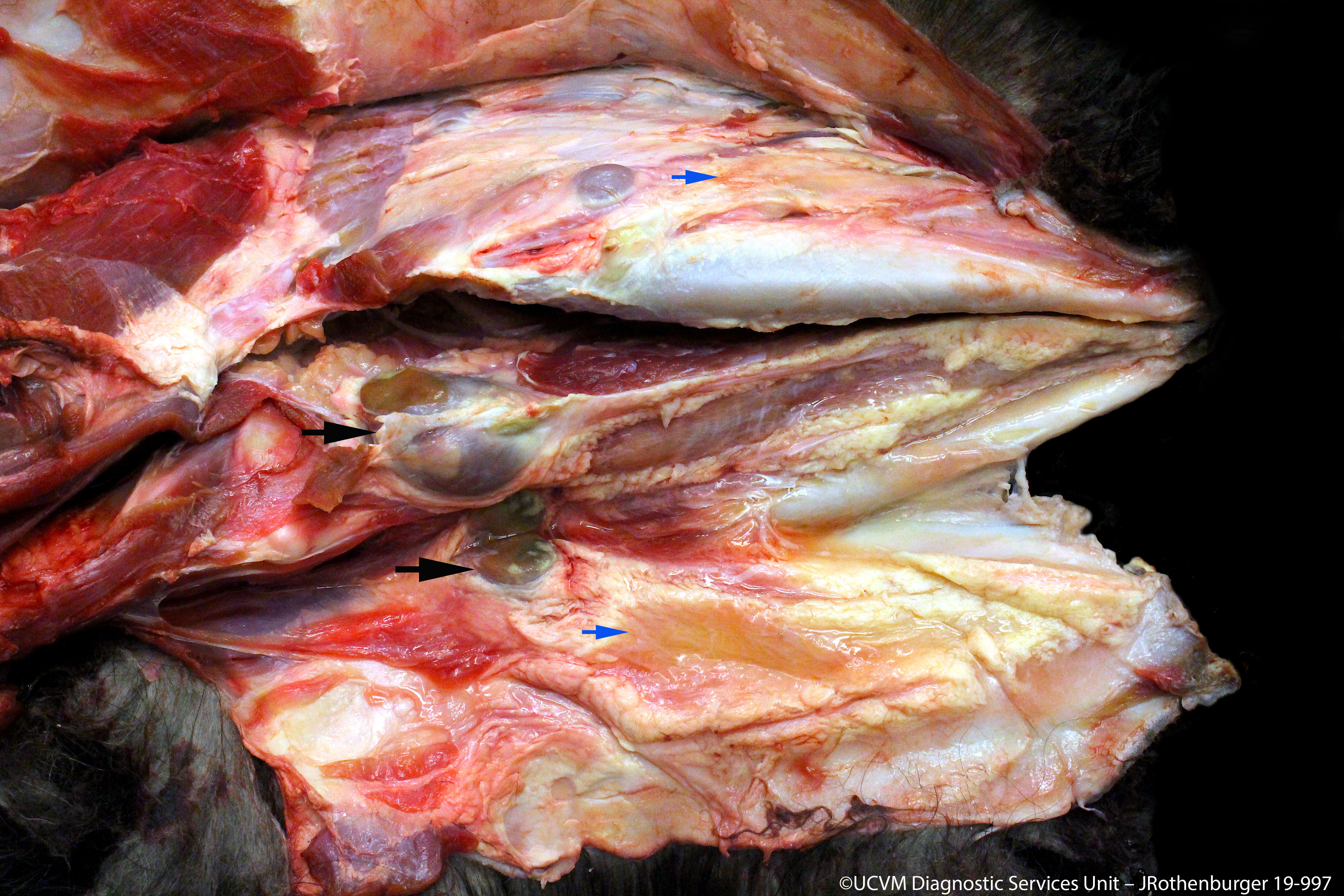
Species: Wild Mammal, Muskox
Specimen:
Head
Shown:
Primary infection of contagious echthyma (Orf virus) causing a proliferative dermatitis and cheilitis. Damage to skin barrier leading to secondary bacterial infection primarily characterized by Corynebacterium freneyi, causing suppurative lymphadenitis and cellulitis of the head eventually leading to terminal septicemia.
Comments:
This case was published in the Journal of Wildlife Diseases. For more information, please see Rothenburger, J. L., Di Francesco, J., Leclerc, L. M., van der Meer, F., Tomaselli, M., Zabek, E., & Kutz, S. J. (2021). Corynebacterium freneyi bacterial septicemia secondary to contagious ecthyma in a wild muskox (Ovibos moschatus). The Journal of Wildlife Diseases, 57(1), 225-229
Pathology:
Contagious Echthyma
General Information:
In the Arctic, contagious echthyma (also known as “Orf”) is a disease found in muskoxen, Dall’s sheep, mountain goats and possibly in moose, wapiti (elk), and caribou. It is caused by a virus and spread by direct contact between animals. Infected animals will have scabs or pus-filled blisters on the lips, mouth, nose, around the eyes and ears, and sometimes on the udder or around the tops of the hooves. These scabs are painful and may make it difficult for the animal to eat and walk, leading them to become weak. In rare cases, these skin infections can lead to deeper, whole-body bacterial infections and death. Contagious echthyma is most common in younger animals. The virus is zoonotic, meaning it can transmit between animals and people.
Pathology:
Contagious Echthyma
General Information:
In the Arctic, contagious echthyma (also known as “Orf”) is a disease found in muskoxen, Dall’s sheep, mountain goats and possibly in moose, wapiti (elk), and caribou. It is caused by a virus and spread by direct contact between animals. Infected animals will have scabs or pus-filled blisters on the lips, mouth, nose, around the eyes and ears, and sometimes on the udder or around the tops of the hooves. These scabs are painful and may make it difficult for the animal to eat and walk, leading them to become weak. In rare cases, these skin infections can lead to deeper, whole-body bacterial infections and death. Contagious echthyma is most common in younger animals. The virus is zoonotic, meaning it can transmit between animals and people.
